


Empowering administrative users to monitor system wide outcomes and individual patient conversations.
The Tom Web Application
As health systems increasingly adopt conversational AI for patient outreach, they require secure and effective methods to oversee these interactions. While Tom provides administrators, providers, and care teams with flexible access through various channels including EHR integration and soon, the Smart on FHIR application, this Product Spotlight focuses specifically on the Tom Web Application. This standalone interface provides a transparent, comprehensive window into all patient communications handled by Tom, the AI care team member. The application serves as a central hub for testing Tom Agentic AI Services, conducting quality surveillance on Tom’s patient conversations, and providing visibility to care team action items. By offering this dedicated oversight platform, healthcare leaders gain the visibility required to trust the technology and scale its use confidently across their enterprise.
Administrative workflows and testing capabilities
The Tom Web Application is structured around three fundamental workflows providing administrative users complete control over the patient engagement process.
First, it acts as a secure sandbox for exploration and testing. Clinical governance committees can initiate sample voice calls or text messages using mock patient data to experience and approve new services before reaching real populations. Dedicated test environments ensure zero risk to actual patient privacy. Users can select specific service protocols, choose simulated patients, and direct communications to their personal phone numbers for convenient, real-world testing. This builds internal consensus and proves the safety of the AI prior to live deployment.
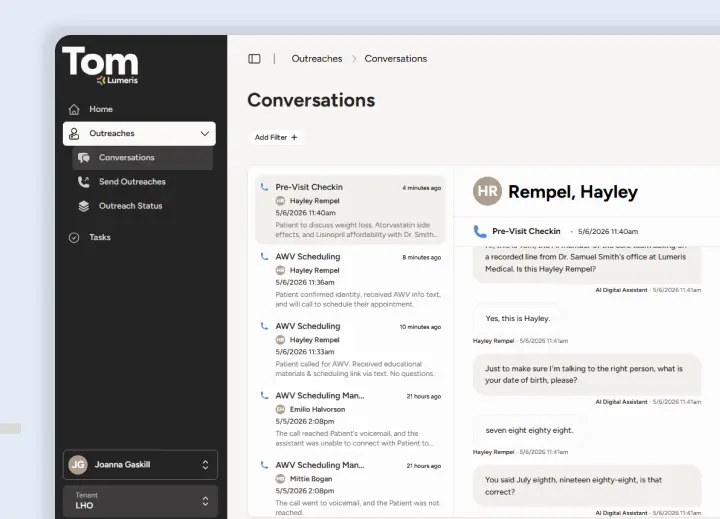
The second core function involves detailed review of conversation outcomes, heavily utilized by program managers and medical directors overseeing outreach quality. Following an interaction, leaders can review a summary of the conversation highlighting the essential outcomes of the call. If they would like to dive deeper, they can listen to call recordings and view full transcripts of Tom’s interactions.
Finally, the application features a robust tasking section to support broader care teams. When Tom identifies an issue requiring human intervention, like a patient requesting a wellness visit or reporting new symptoms, it creates a specific task. The system routes these alerts intelligently. If a patient with an upcoming appointment mentions a non-urgent issue, the information is seamlessly added to their visit summary. If a patient reports symptoms without a scheduled visit, Tom evaluates the urgency and either advises contacting emergency services or creates a detailed task for immediate care team follow up.
Use Case: Intelligent summaries and task routing
To understand how these workflows operate in practice, consider an example interaction with a patient. During a routine outreach call, a patient shares two critical pieces of information with Tom. They express a personal goal to lose 10 to 20 pounds and that they are currently experiencing nausea from one of their prescribed medications. A program manager utilizing the Tom Web Application to monitor call quality can review the complete outcome of this interaction almost immediately.
Rather than forcing a clinician to listen to the entire audio recording or read a lengthy transcript to discover these details, the system automatically generates a detailed summary capturing both the weight loss goal and the adverse medication side effect. Because the nausea requires clinical attention, the system intelligently adapts. The program manager can use the web application to see the detailed summary, listen to the specific audio segment to confirm Tom responded with appropriate empathy, and verify that the information was properly routed. When the clinical staff opens the patient’s EHR record, the exact details of their weight loss goals and medication concerns are already present, ensuring the care team is fully prepared to assist during the visit.
Enterprise-wide surveillance and quality management
Frontline clinicians interact with AI outputs directly within their patient specific charts in the Electronic Health Record. However, the Tom Web Application is exclusively tailored for administrative users requiring a system wide perspective. To preserve clinical efficiency, physicians and nurses remain within their familiar charting systems, while administrators use the web application to view AI activity across the entire organization.
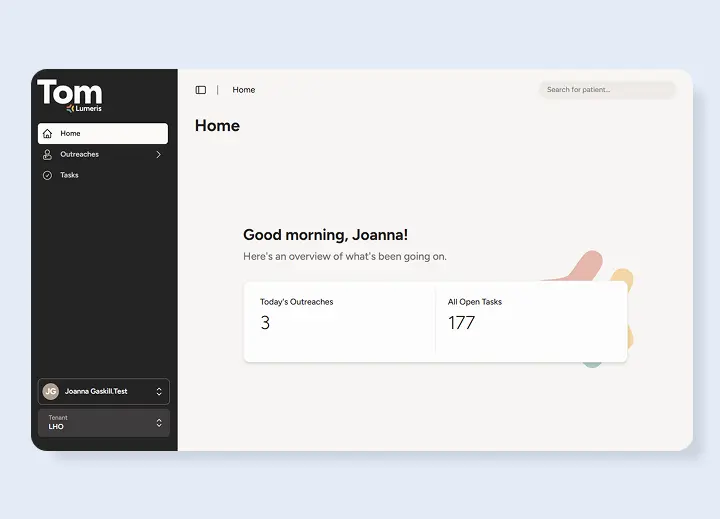
Text conversations appear in real time, and voice call data is available within a few minutes of the call concluding. This aggregate population view allows administrators to track operational volume, monitor patient engagement, and verify platform health without opening individual patient charts. It transforms AI management from a fragmented task into a streamlined, centralized surveillance operation.
Stringent security measures and clinical record integration
The Tom Web Application is HIPAA compliant, adhering strictly to federal healthcare privacy and security regulations. Data is encrypted in transit and at rest, and information is segmented by customer to prevent any unauthorized access. Access is controlled through a secure login leveraging federated access, or single sign on. The application plugs directly into an organization’s existing security infrastructure, authenticating users through familiar internal systems, and reducing the burden on technology departments.
To protect privacy during outbound outreach, Tom employs mandatory safeguards. When initiating a call, Tom asks to speak to the specific patient by name. If the answering individual is not the patient or someone authorized to speak on the patient’s behalf, the call politely terminates. For enhanced security, a second verification layer requires the patient’s date of birth before proceeding with clinical dialogue. Once a conversation is complete, summaries and tasks are simultaneously syndicated to the EHR. This creates a cohesive flow of information, with encounters appearing in the patient chart and tasks routed to appropriate clinician work queues.
Customization for brand and operational alignment
Patient trust relies heavily on familiarity and localized branding. The application provides a standardized interface while keeping the underlying conversational AI adaptable. Implementation teams collaborate with health systems to tailor the outreach experience, ensuring interactions reflect the distinct identity of the organization rather than feeling outsourced. Organizations dictate the exact scheduling phone numbers Tom provides, routing inbound calls correctly to local clinics. The specific names of practices, regional facilities, and health systems are programmed, so Tom speaks using familiar, community specific terminology. Digital contact cards delivered via text message are also fully tailored to contain the practice’s logo and preferred contact information.
Beyond branding, the platform offers advanced configuration for workflow alignment and regulatory compliance. Organizations can activate or deactivate specific services down to the individual provider level. For instance, a practice with five physicians can configure the system so only four participate in a specific outreach campaign. Additionally, health systems can define exact outreach time windows, ensuring Tom only initiates communications during approved hours that align with operational schedules and patient expectations. To further safeguard the patient experience, the platform enforces strict communication limits in accordance with Telephone Consumer Protection Act (TCPA) guidelines. For individuals with an existing business relationship, the system automatically restricts unsolicited outreach to a maximum of one call per day or three calls per week, ensuring regulatory compliance while actively preventing communication fatigue.
Strategic roadmap and future platform advancements
The Tom platform continuously evolves to offer greater flexibility and deeper insights. Future updates will focus on advancing analytical reporting by integrating robust data exploration tools directly into the web application interface. This enhancement will empower leaders to analyze massive datasets of patient interactions, allowing administrators to uncover trends in engagement and operational efficiency without navigating away from the platform. Upcoming releases will also expand the granular control organizations have over service deployment, ensuring health systems can adopt new AI capabilities at their own pace and according to specific strategic priorities.

