

Healthcare executives today face one of the most difficult operating environments in decades. Margins are narrowing as costs rise, reimbursement models tighten, and competitive disruption intensifies across nearly every market. At the same time, the workforce crisis has reached critical levels. Clinician burnout is accelerating workforce attrition,1 and the United States is projected to face a shortfall of more than 87,000 primary care physicians by 2037.2 Even if new providers are trained at scale, meeting this demand would require hundreds of millions of additional care hours each year, representing trillions of dollars in workforce costs. Delayed care is already contributing to worsening outcomes,3 while shortages are particularly severe in rural communities.4
Yet within these pressures lies a powerful opportunity. Primary care transformation, supported by agentic AI, is an effective and often overlooked way to align financial sustainability with clinical excellence. Unlike generative AI, which provides insights, agentic AI acts inside workflows to expand capacity, reduce avoidable utilization, and improve outcomes.5 This shift enables healthcare leaders to simultaneously strengthen financial performance and elevate patient care.
Healthcare leaders are presented with new ideas every day for how to grow revenue, improve margins, gain market share, and manage costs. The path forward is not a choice between financial strength and clinical excellence. Primary care transformation shows that improving financial outcomes is inseparable from improving clinical outcomes, and the most transformative solutions achieve a balance of both.
Primary care transformation is a smart, viable strategy that forward-thinking executives are already beginning to explore. While many organizations are experimenting with AI, generative AI will only advance your priorities so far. The future belongs to primary care transformation enabled by agentic AI.
This brief will explore why investing in primary care transformation is a high-impact strategy for healthcare leaders seeking sustainable revenue growth, stronger margins, expanded market share, and tighter cost control.
Revenue Growth Through Stronger Patient Engagement
Revenue capture remains a top opportunity for healthcare leaders, however many health systems are losing potential patient revenue to competitors. Leakage and fragmented engagement continue to erode financial performance. For CEOs and CFOs, this represents not only lost revenue but also a missed chance to strengthen long-term patient relationships that build loyalty and utilization.
Unlike traditional AI, which surfaces insights for leaders to interpret, agentic AI acts autonomously within workflows. It engages patients directly with timely, personalized outreach, closes gaps in preventive care, and supports continuity between visits. This ensures revenue growth is rooted in long-term patient value rather than isolated encounters.
Agentic AI brings together data across the enterprise including clinical records, pharmacy activity, claims, and social factors to create a complete view of the patient. With this foundation, it can tailor engagement so that it feels relevant and human instead of transactional or generic. Research shows that personalized outreach increases adherence to preventive care and boosts satisfaction, both of which directly strengthen downstream revenue.
With these capabilities, health systems can anticipate patient needs, close care gaps, and expand capacity and staffing for profitable services. For executives operating in an environment where one in four healthcare CFOs report that operating margins have fallen short of goals over the past three years,6 primary care transformation powered by agentic AI provides a scalable path to sustainable revenue growth and margin stability.
Margin Protection and Expansion
Margin protection and expansion are consistent priorities for healthcare executives. Traditional models often tolerate inefficiencies as long as billing offsets costs, but this cycle is increasingly unsustainable as reimbursement tightens and costs rise. For CEOs and CFOs, breaking this cycle is essential to building financial resilience. Preventive primary care reduces avoidable admissions and readmissions, while coordinated care lowers duplication and unnecessary utilization. When combined with agentic AI, these benefits scale even further.
Agentic AI can streamline both clinical and administrative workflows by automating documentation, eliminating redundancies, and intelligently routing patients to the most appropriate and cost-effective services. This reduces workforce strain, improves operational efficiency, and ensures resources are aligned with revenue-generating activities.
For CFOs, the impact is clear: higher-margin revenue opportunities emerge without the proportional increase in costs that typically erode returns. Executives are already recognizing this shift. Surveys show CFOs increasingly view AI not merely as a tool for efficiency but as a driver of sustainable growth and profitability.7 For health system leaders under pressure to do more with less, margin expansion through agentic AI represents a practical, scalable solution.
Market Share and Competitive Differentiation Through Patient Care
Market share is one of the most visible measures of CEO and CFO performance, directly tied to organizational growth and leadership stability. Once lost, it is extraordinarily difficult to recover, making proactive strategies essential to success. Primary care serves as the decisive differentiator in competitive markets, particularly in metropolitan areas where multiple health systems compete for the same patient base. Expanding access, improving coordination, and embedding agentic AI into primary care delivery allows executives to move beyond traditional referral management toward durable patient loyalty. To attract and retain patients and grow market share, health systems need to create a competitive advantage that rivals cannot easily match. While many healthcare leaders are using generative AI as a solution to drive efficiency and improve market share it is health systems that use Agentic AI systems that will be able to grow market share through improved patient care.
Market share in today’s environment is shaped primarily by two levers: reducing leakage and increasing panel size. Leakage, where patients seeking care outside the system erodes both revenue and loyalty. By strengthening referral pathways, improving care coordination, and ensuring a seamless patient experience, health systems can improve keepage, retaining more care in-network. Higher patient satisfaction further reinforces this cycle, driving durable loyalty and protecting market share.
Panel size is equally important. With clinician shortages and mounting patient demand, most systems are constrained in their ability to expand. Agentic AI supports transformation here by automating routine workflows and coordinating care across the continuum. By freeing provider capacity, reducing administrative burden, and supporting chronic disease management, health systems can safely increase panel size without overwhelming clinicians. More patients can be served, and each receives more consistent, proactive care strengthening both access and loyalty.
For healthcare leaders, the result is sustained revenue streams, stronger patient loyalty, and long-term financial positioning. Systems that embrace primary care transformation with agentic AI will be positioned to capture and grow market share, even in crowded and highly competitive markets. With agentic AI solutions health systems can deliver accessible, patient-centered primary care supported by intelligent technology that guides the best next action for the patient that won’t delay care which drives worsening outcomes.8
Operating Cost Management: Efficiency as a Driver of Growth
Operating costs remain one of the most stubborn challenges for health system executives. Inefficient, siloed profit centers and heavy administrative overhead drain resources that could otherwise be invested in patient care and strategic growth. For healthcare leaders, these inefficiencies erode value and make it difficult to sustain margin stability. Primary care transformation offers a coordinated model that cuts across silos, optimizes resource allocation, and eliminates duplication. When supported by agentic AI, these gains expand significantly.
Agentic AI acts inside workflows to streamline care coordination, support chronic disease management, and reduce unnecessary duplication of services. By automating follow-ups, triaging patients to the most appropriate care, and ensuring continuity between visits, agentic AI frees provider time and reduces administrative burden. This additional capacity allows leaders to expand panel size, serve more patients without proportional cost increases, and lower reliance on high-cost, avoidable interventions.
Equally important, AI-driven care coordination reduces unnecessary utilization and ensures patients receive the right care at the right time. These models lower the total cost of care while maintaining quality. In rural markets, where shortages are especially severe,4 such efficiencies are not only essential to financial resilience but also critical to ensuring equitable access to care.
Executive Call to Action
Primary care transformation supported by agentic AI can give healthcare executives control over aspects of the four levers that matter most: revenue growth through stronger patient relationships, margin expansion through efficiency and prevention, market share gains through differentiation, and operating cost reductions through automation and coordination. Together, these outcomes create greater capacity to serve more patients, improve resource utilization, and build organizations that can thrive in uncertain markets.
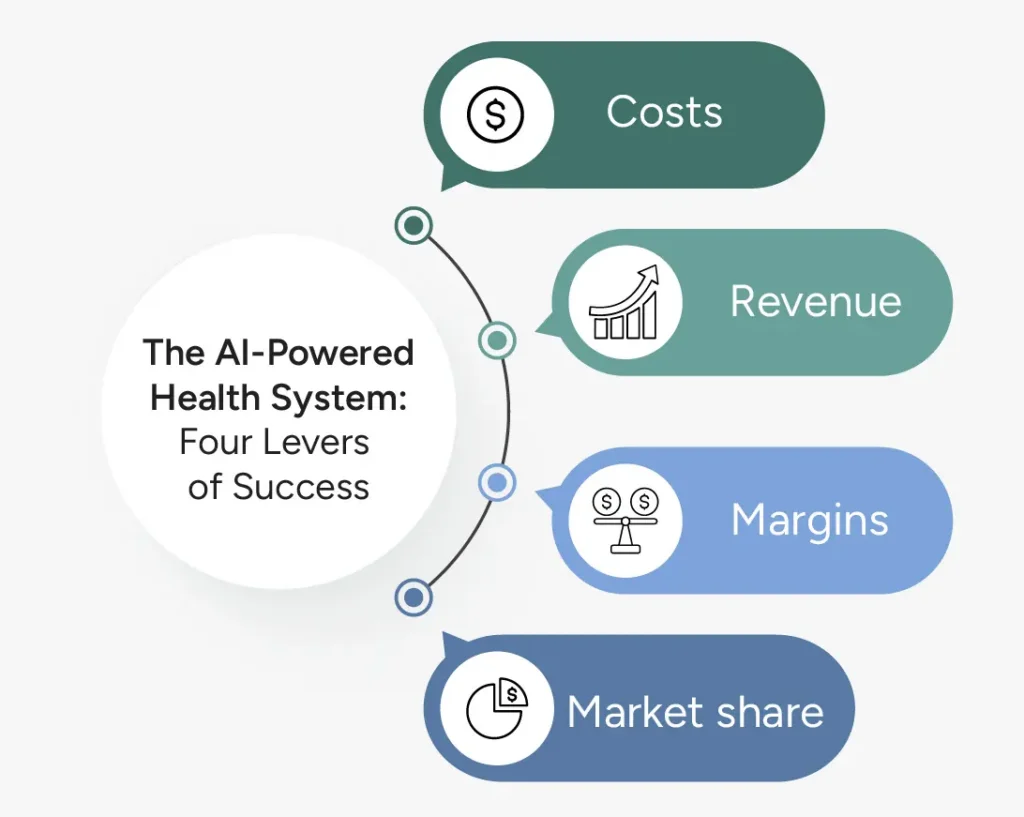
For healthcare leaders, the imperative is clear. Primary care transformation, enabled by agentic AI, proves that revenue growth, margin stability, market share expansion, and cost control are not competing objectives but mutually reinforcing ones. The systems that act decisively will secure sustainable growth, enhance financial resilience, and position themselves as market leaders. Those that wait will face the risk of being outpaced by competitors who make primary care the strategic engine of both clinical and financial performance.
Agentic AI also creates a future where proactive engagement, personalized care, and scalable capacity are not aspirational goals but operational realities. By embedding intelligence into daily workflows, health systems can reduce readmissions, increase patient satisfaction, and strengthen long-term loyalty. For healthcare leaders, this means not only balancing financial stability with clinical excellence but advancing both at the same time.
The question for today’s executives is no longer whether to transform primary care, but how quickly they can bring this transformation to scale.
Schedule a Tom Demo
References
- The American Journal of Medicine. (n.d.). Physician burnout leading to workforce attrition. https://www.amjmed.com
- AAMC. (n.d.). Aging population increasing demand for physicians. https://www.aamc.org
- ODPHP. (n.d.). Delayed care resulting in worse health outcomes. https://odphp.health.gov/healthypeople/priority-areas/social-determinants-health/literature-summaries/access-primary-care
- National Library of Medicine. (2023). A shortage of doctors in rural America. PubMed Central. https://pmc.ncbi.nlm.nih.gov/articles/PMC1071163/
- PwC. (2024). Agentic AI: The new frontier in generative AI—An executive playbook. https://www.pwc.com/m1/en/publications/documents/2024/agentic-ai-the-new-frontier-in-genai-an-executive-playbook.pdf
- Deloitte. (2024). Healthcare CFOs embrace comprehensive approach to profitability. https://www.deloitte.com/us/en/insights/industry/health-care/health-care-cfos-embrace-comprehensive-approach-to-profitability.html
- Salesforce. (2024). CFOs invest in AI for growth. https://www.salesforce.com/news/stories/cfos-invest-ai-for-growth/
- Office of Disease Prevention and Health Promotion. (n.d.). Access to primary care. Healthy People 2030. U.S. Department of Health and Human Services. Retrieved from https://odphp.health.gov/healthypeople/priority-areas/social-determinants-health/literature-summaries/access-primary-care