




How Tom extends the reach of your clinical system
The Electronic Health Record is the foundational system of modern healthcare. Health systems have invested heavily in these platforms to modernize care delivery. As a result of these operational investments, EHRs have become the system of record and are now the navigation center for critical clinical information that spans across the continuum of care and intra-visit communications. Tom acts as an intelligent extension of the clinical system to unlock the full potential of this data. Through deep integration, Tom transforms static chart data into automated and proactive patient engagement. This allows health systems to scale their outreach efforts and drive population health.
Partnering for technical implementation
Implementing an AI operating system involves adapting to the existing clinical infrastructure of the organization. The Tom engineering and clinical informatics teams work with health system IT leaders to design an integration architecture that is robust, scalable, and configurable to unique needs. The process begins with a technical discovery phase where the team evaluates and aligns on both clinical and operational goals. For incoming data, we propose a standard data specification for secure, automated clinical data feeds and then work collaboratively with the health system to discuss and tweak our customizable professional services to align as closely as is reasonable with their unique goals and needs.
For documenting Tom’s patient interactions within the EHR, we rely exclusively on industry standards. This involves working directly with the health system’s IT team to utilize their standard interfaces: selecting appropriate encounter and note types, setting up a dedicated AI provider record for clear attribution, and mapping specific task categories to designated flowsheet rows.
The deployment process requires establishing secure, reliable data pipelines. Integration specialists work with client IT staff as they configure the comprehensive nightly data feeds that form the foundation of our clinical insights. During the staging and testing phases, the focus shifts to robust interface configuration and access control. We guide client IT staff in configuring and exposing industry standard interfaces. Behind the scenes, our integration layer seamlessly translates data payloads into industry standard clinical messaging formats. The deployment concludes with user acceptance testing in a non-production environment to verify that encounters are created correctly and all data routes accurately before going live.
How the EHR powers Best Next Action
With the integration foundation in place, the focus shifts to the clinical data that powers Tom’s decision making. Tom receives foundational clinical data via secure, automated nightly feeds. To supplement this information, real-time FHIR API queries are employed when up to the minute clinical context is absolutely critical. This strategic flow of clinical data is what ultimately powers the Best Next Action engine.
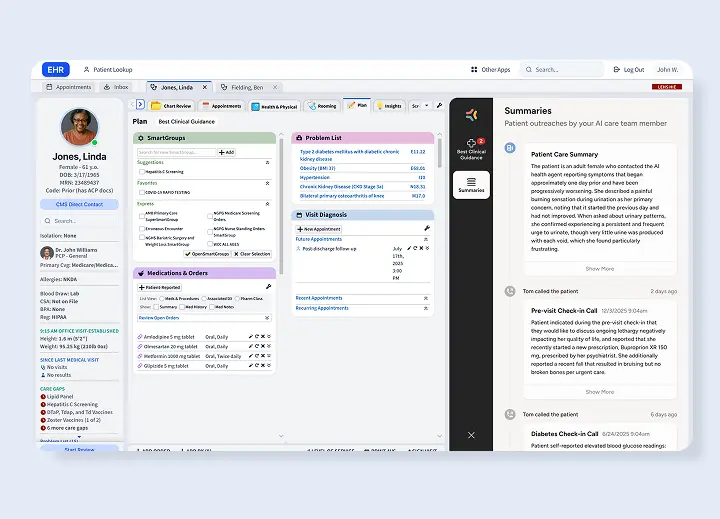
By analyzing the latest lab results, encounter histories, problem lists, and demographic data natively housed in the EHR, the system can pinpoint exactly which patients require attention. This seamless connection ensures that the Best Next Action engine always operates on the most current and accurate clinical reality. With this integration, Tom can dynamically trigger highly specific and clinically relevant engagement tailored to the unique medical needs of every patient.
Translating data into preventive and chronic care
As Tom is deeply integrated with the clinical system, it can seamlessly translate these insights into immediate and tangible action. When the EHR data indicates a gap in care, Tom reaches out to the patient on behalf of the clinical care team, to close it before a minor issue becomes a major health event.
For prevention and wellness, Tom continuously monitors the EHR data for patients who are overdue for critical screenings or Annual Wellness Visits. Once the system identifies a qualified patient, Tom can initiate a phone call to book the appointment directly via API, provide a warm handoff to your call center, or text a deep link directly to the EHR patient portal.
For chronic care management, the platform relies on EHR data to trigger targeted conversations. If the data shows a patient with a history of hypertension, Tom can proactively call to check on medication adherence, monitor reported side effects, and collect current blood pressure vitals. If any of these interactions surface a symptom or response that warrants clinical attention, Tom flags the information and intelligently routes it directly to the specific care team, defined by the health system, for review, so the patient’s chronic conditions are managed continuously rather than episodically during clinic visits.
Native workflow and seamless documentation
A successful clinical tool must live exactly where providers already work. Tom eliminates software fatigue through purposeful EHR write-backs. The overarching goal is that all outreach activity is conveyed and persisted within the medical record.
Every patient interaction orchestrated by Tom is automatically written back to the patient chart as a distinct encounter (e.g., “Patient Outreach”). Full conversation transcripts, concise summaries, and patient reported vitals are reflected as Progress Notes, and as discrete values where applicable, authored by a designated AI Agent. This ensures complete reportability and auditability, while maintaining a single source of truth where all outreach activity is persisted and easily viewable by each care team member within their existing user interface.
When an interaction reveals a complex issue requiring human intervention, Tom intelligently routes tasks to the appropriate team or individual within the EHR, based on the health system’s specific configurations. These alerts can be configured to route directly to the appropriate clinical inbox. Whether surfacing a medication question to an Epic In Basket or alerting a care manager in Compass Rose, the workflow remains entirely native to the clinical system. Clinical staff never have to log into a separate portal or learn a new software interface to see what Tom has identified or accomplished.
Driving operational and clinical quality
By establishing a robust technical integration with the EHR upfront, Tom acts as a primary driver of operational efficiency and clinical quality. It ensures that the wealth of data within the EHR is proactively utilized to engage patients rather than sitting dormant between appointments. This integrated approach brings genuine scale to population health initiatives. Most importantly, it allows clinical teams to focus their specialized expertise on direct patient care and complex decision making rather than routine administrative tasks.