

Across the healthcare landscape, one truth has become impossible to ignore: there simply aren’t enough clinicians to meet patient demand. As health systems navigate shrinking margins, physician burnout, and growing complexity in chronic disease management, the question isn’t whether to change the care model, it’s how to scale it sustainably.
In a recent episode of Blank Rome’s Bright Minds in Healthcare Delivery podcast, Rick Goddard, Lumeris’ Senior Vice President of Market Alliances, described how agentic AI is helping health systems extend care capacity and move up the population pyramid to engage patients earlier and more effectively.
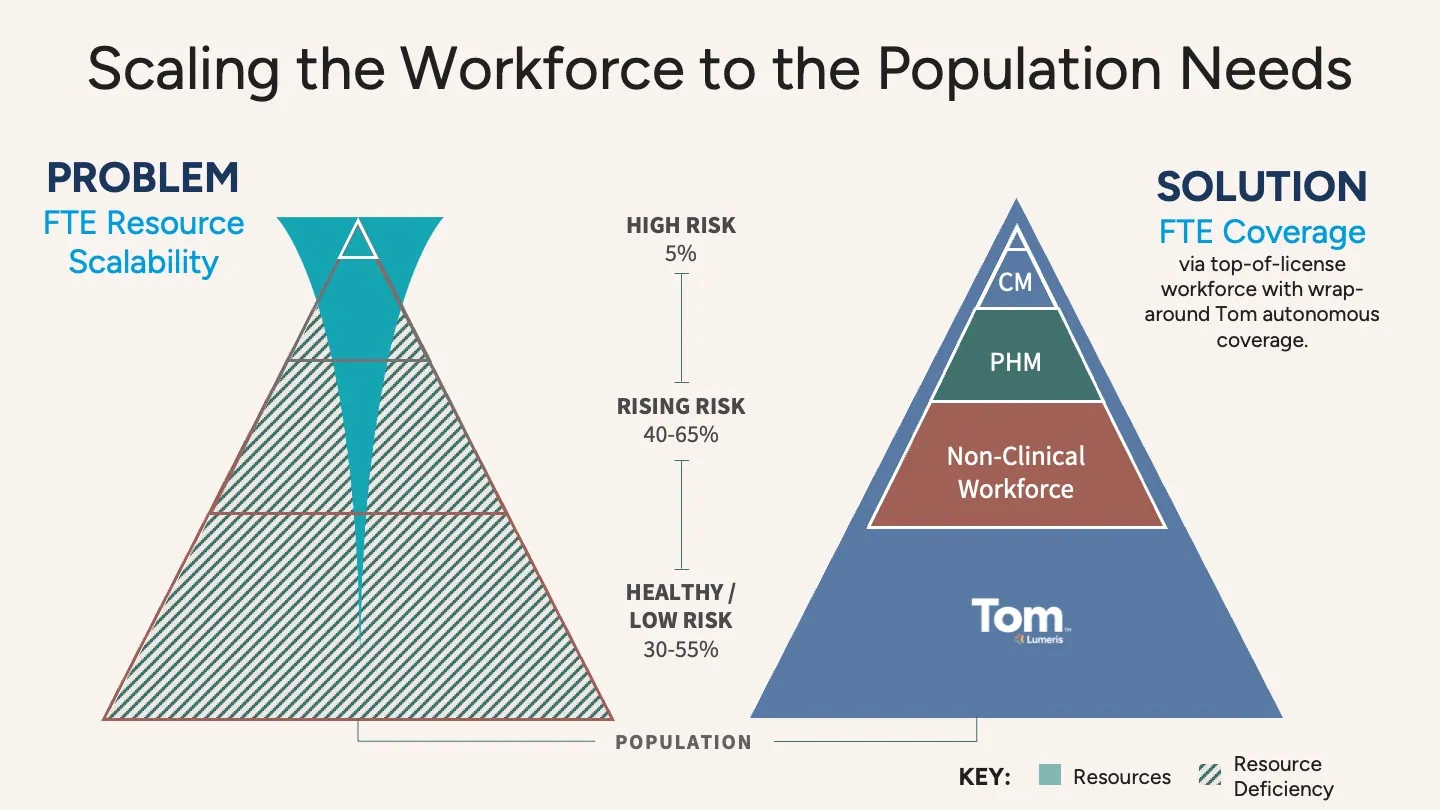
The Untapped Middle of the Population Pyramid
Every health system knows the pyramid. At the top are the sickest 5% of patients who account for the majority of costs. Historically, care teams have concentrated resources here through intensive care management programs and risk-based oversight.
But below that top tier lies an often-overlooked segment: the rising-risk population. These are the patients with emerging chronic conditions, lifestyle risk factors, or social barriers that, if left unaddressed, can escalate into high-cost episodes. As Rick explained, this group represents “greater than 40 percent of the population,” yet most systems “haven’t had the human bandwidth to manage them effectively”.
Traditional care management models can’t scale that far. That’s where AI-driven automation and agentic systems come in.
What Agentic AI Makes Possible
Unlike earlier generations of AI that simply provided recommendations, agentic AI can act. These systems don’t just predict who might need care, they can initiate actions on behalf of care teams.
For example, an agentic AI system can:
- Identify a patient turning 45 and automatically prompt scheduling for a preventive screening.
- Detect transportation barriers from SDOH data and coordinate a virtual follow-up instead of an in-office visit.
- Nudge a patient overdue for medication refills or an annual wellness visit through their preferred communication channel.
Each of these interventions can be fully automated or coordinated through an AI “care team member” that extends human clinicians, freeing them to operate at the top of their license.
From Insights to Impact: Primary Care as a Service
At Lumeris, this is more than theory. It’s the foundation of our Primary Care as a Service (PCaaS) model powered by Tom™, our AI platform designed to bring agentic intelligence directly into clinical and operational workflows.
By pairing Tom™ with our physician-first operating model, health systems can:
- Expand reach across the full population, not just the top 5%.
- Strengthen engagement through personalized, proactive touchpoints.
- Improve outcomes and margins by preventing avoidable acute events.
It’s how we help organizations turn data into daily action; bridging the gap between insight and execution.
Reimagining the Role of Primary Care
AI won’t replace the clinician, it will extend them. As Rick emphasized, adoption depends on change management and trust.
Physicians who once resisted new technology are now asking for tools that help them focus on what matters most: their patients. When AI-driven assistants take on the administrative and outreach burden, clinicians gain time for higher-value interactions and deeper patient relationships.
The future of primary care won’t be defined by automation alone, but by how intelligently technology and human expertise come together.
The Bottom Line
To manage the “rising-risk” middle of the population pyramid, health systems need more than analytics, they need actionable automation.
Agentic AI, delivered through Primary Care as a Service, is how Lumeris helps organizations reach more patients, reduce burden, and strengthen performance.